Before you write: align the internal team
The writing is rarely the hardest part. The hard part is getting internal agreement on what the project must accomplish. A 1 hour alignment session can prevent weeks of contradictory edits later.
Before drafting the RFP, identify:
- The executive sponsor and final decision-maker
- The day-to-day project lead
- The departments or user groups that need to be consulted
- Who owns content, approvals, technology, privacy and accessibility
- The approved budget or a realistic working range
- Which requirements are mandatory, desirable or still open to recommendation
That last distinction is especially useful. If you mark every request as mandatory, vendors cannot show you where trade-offs exist. A simple “must have / should have / could have” label makes priorities visible without pretending every decision is final.
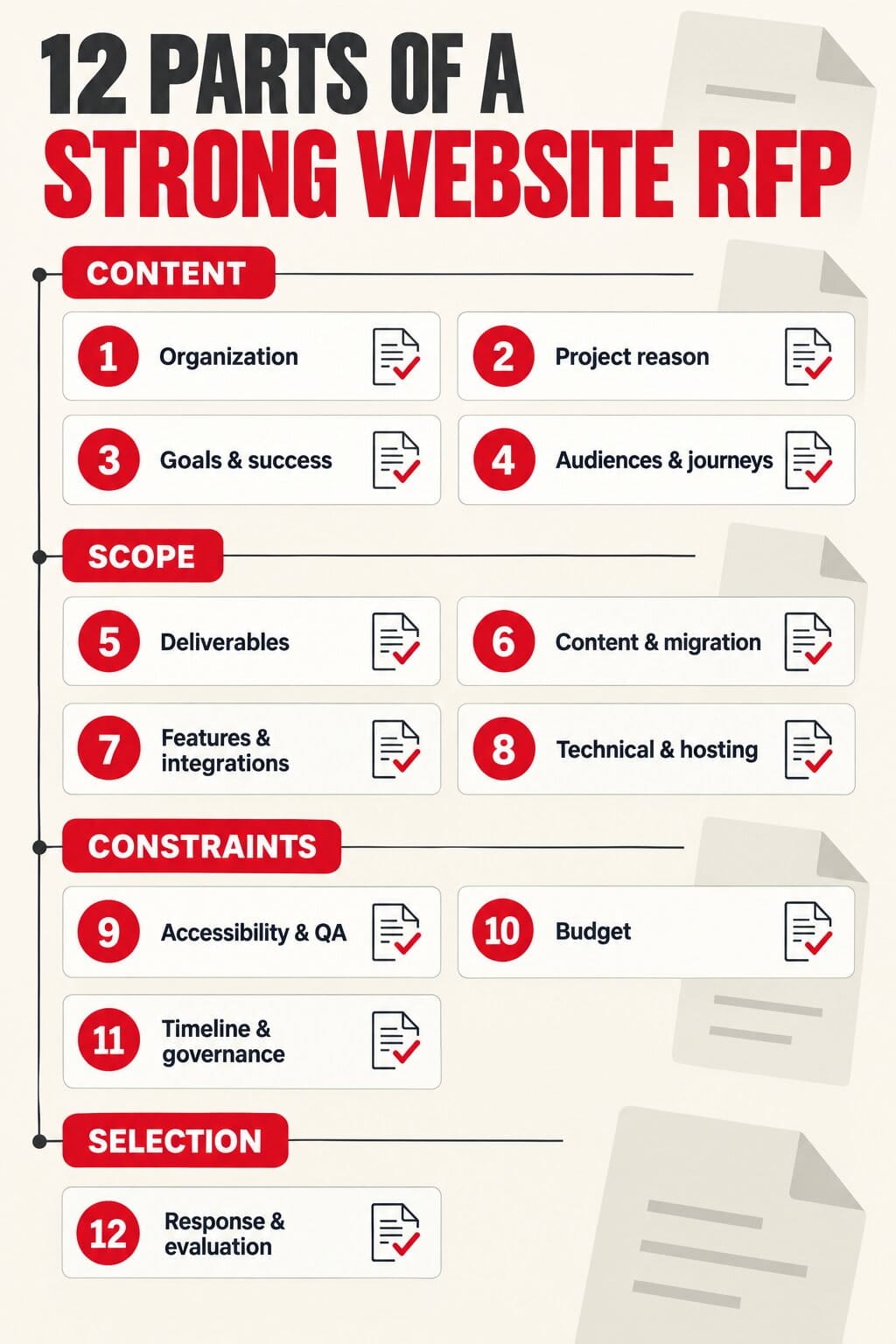
The 12 sections of a strong website RFP
You can use the following structure as a practical website RFP template. The amount of detail will vary by project, but each section should give agencies information they can use to shape their approach, team, schedule and price.
1. Organization overview
Introduce the organization in plain language. Explain what you do, who you serve, where you operate and how the website supports the broader mission or business model. Link to your current site, strategic plan or annual report only when it adds useful context. Keep this section focused. A vendor needs enough background to understand the organization, not its complete history.
2. The reason for the project
Describe what is driving the redesign now. Is the current site hard to update? Has the organization changed? Are users unable to find important information? Is the visual identity dated? Are accessibility, performance, security or integration issues creating risk? Be candid. Specific problems lead to specific responses. “We need a modern website” is far less useful than “Our navigation reflects our internal departments, while users arrive by service need and cannot find the right next step.”
3. Goals and measures of success
List a small number of project goals and explain how you will recognize progress. A redesign might aim to increase qualified inquiries, improve donation completion, reduce calls for routine information, make mobile tasks easier, support recruitment or give staff more control over publishing. Where possible, include a baseline and a measurement method. If no baseline exists, say that measurement planning should be part of discovery. Avoid promising an arbitrary traffic or conversion increase before the strategy and data have been reviewed.
4. Audiences and priority user journeys
Name the people who use the site and what they are trying to accomplish. “General public” is rarely enough. A professional association may serve members, prospective members, employers, media, staff and the public. A construction company may serve property owners, general contractors, architects and job applicants. For each priority audience, describe two or three important tasks. This gives agencies a better basis for discussing information architecture, content and calls to action.
5. Scope and expected deliverables
State what you believe is included: research, strategy, sitemap, wireframes, visual design, copy support, development, CMS setup, content entry or migration, integrations, testing, training, launch and post-launch support. If you want vendors to recommend the right scope, say so and ask them to explain any changes.
Separate firm requirements from optional items. For example, a member portal may be a later phase, while single sign-on planning must be considered now. That separation lets agencies price the core project and alternatives clearly. If you are still deciding between a template-based approach and a fully custom build, describe the outcomes and constraints instead of prescribing one. An experienced partner can explain the trade-offs within its proposal for custom website design and development.
6. Content responsibilities and migration
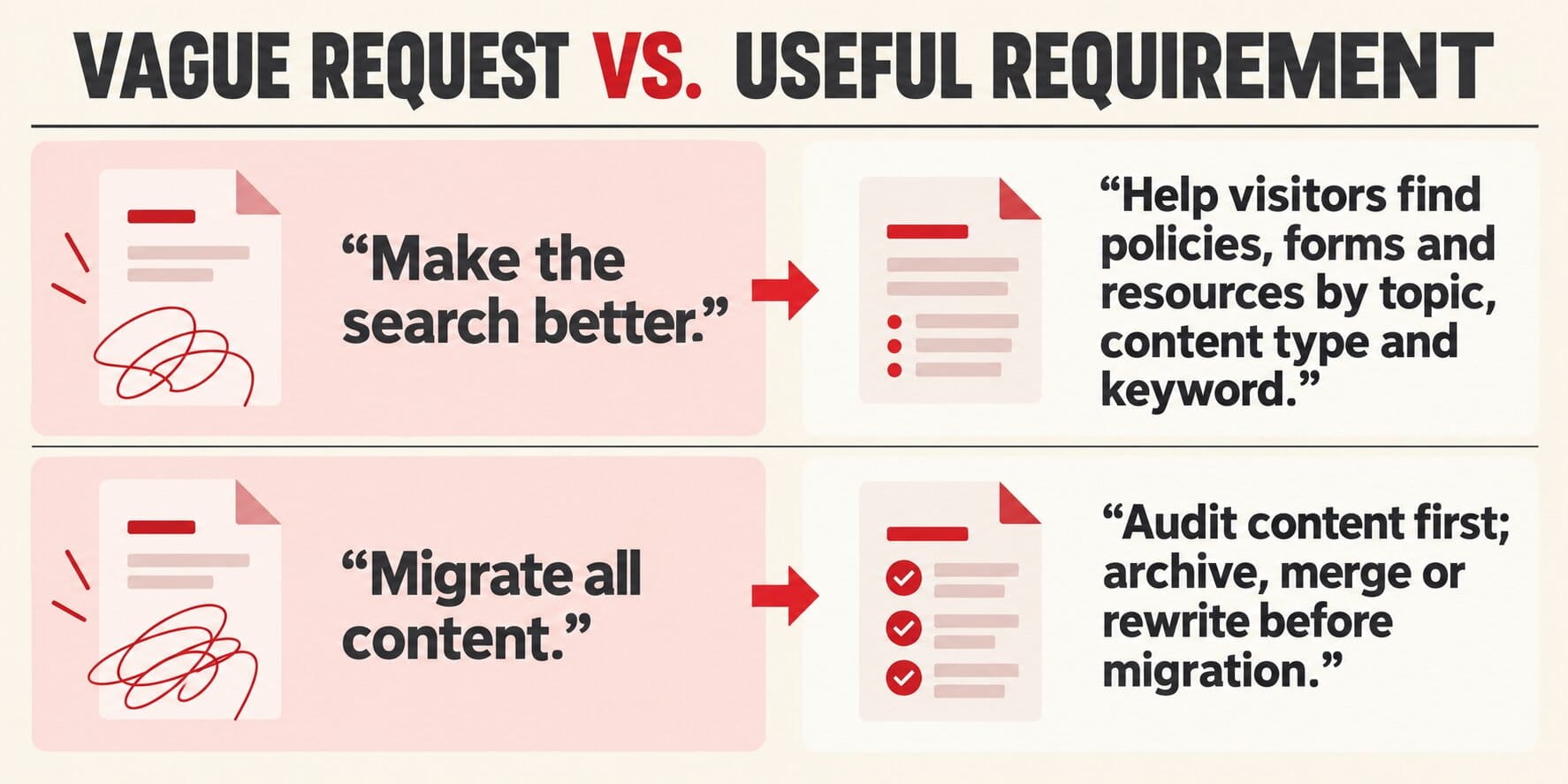
Content is one of the biggest sources of schedule and budget variance, yet it is often summarized in one sentence. Provide a current page count, note which sections will be removed or consolidated, and identify documents, news, profiles, products, events or multilingual content that may need migration. Clarify who will audit, write, edit, approve and enter content. If the answer is not known, ask vendors to price content strategy, copywriting coordination and migration as separate options. Also identify who will supply photography, video, brand assets and legal text. On most WordPress websites, you can go to [yoururl.com]/sitemap.xml to get a full list of pages on your website.
7. Functionality and integrations
Describe the user need behind every requested feature. Instead of asking for “a searchable directory,” explain who searches, what they search by, what information appears and where the data comes from. List known systems such as a CRM, association-management platform, donation processor, email-marketing tool, job board, event platform, analytics account, payment gateway or single sign-on provider. Include documentation and technical contacts where possible. If a current integration is unreliable, say so.
8. Technical, hosting, security and privacy context
Share the current CMS, hosting environment, domain ownership and any contractual constraints. Note required environments, backup expectations, disaster recovery, data residency, security review, privacy review and third-party services that the selected partner will need to coordinate. Do not invent technical requirements because they sound safe. State the organizational or regulatory need and invite the agency to explain how its proposed architecture addresses it. Your IT and privacy leads should review this section before release.
9. Accessibility, performance and quality assurance
Replace vague phrases such as “the website must be accessible” with testable expectations. Identify the accessibility standard and conformance level that applies to your organization, the types of automated and manual testing expected, the required documentation and who is responsible for fixing issues found before launch.
The same applies to performance and browser support. Define priority devices, critical journeys and acceptance criteria, then ask vendors to describe their testing process. Use the current W3C Web Content Accessibility Guidelines and applicable Ontario requirements as starting points, and confirm your organization’s obligations with the appropriate legal or accessibility advisor.
10. Budget and commercial assumptions
Include an approved budget or a credible range. A budget is not an invitation for every agency to charge the maximum. It lets vendors determine whether the objectives are realistic and propose the best mix of research, design, development and support within the available investment. Ask for fees by phase and identify what should be priced separately: taxes, licensing, stock assets, hosting, ongoing maintenance, third-party subscriptions, travel and optional features. If you are still establishing the budget, our guide to how much a website costs in Canada explains the variables that tend to move a project up or down.
11. Timeline, governance and procurement process
Provide the desired launch window and the business reason behind it. Then list the RFP issue date, deadline for questions, response date, interview period, selection date and anticipated kickoff. For a moderately complex private-sector process, giving agencies roughly 2-4 weeks to respond is often more realistic than asking for a thoughtful proposal in a few days. Explain how many stakeholder groups will review the work, who consolidates feedback and how quickly approvals can be provided. If your organization is subject to a formal procurement policy, follow the current rules for communications, addenda, evaluation, conflicts and records.
12. Proposal format and evaluation criteria
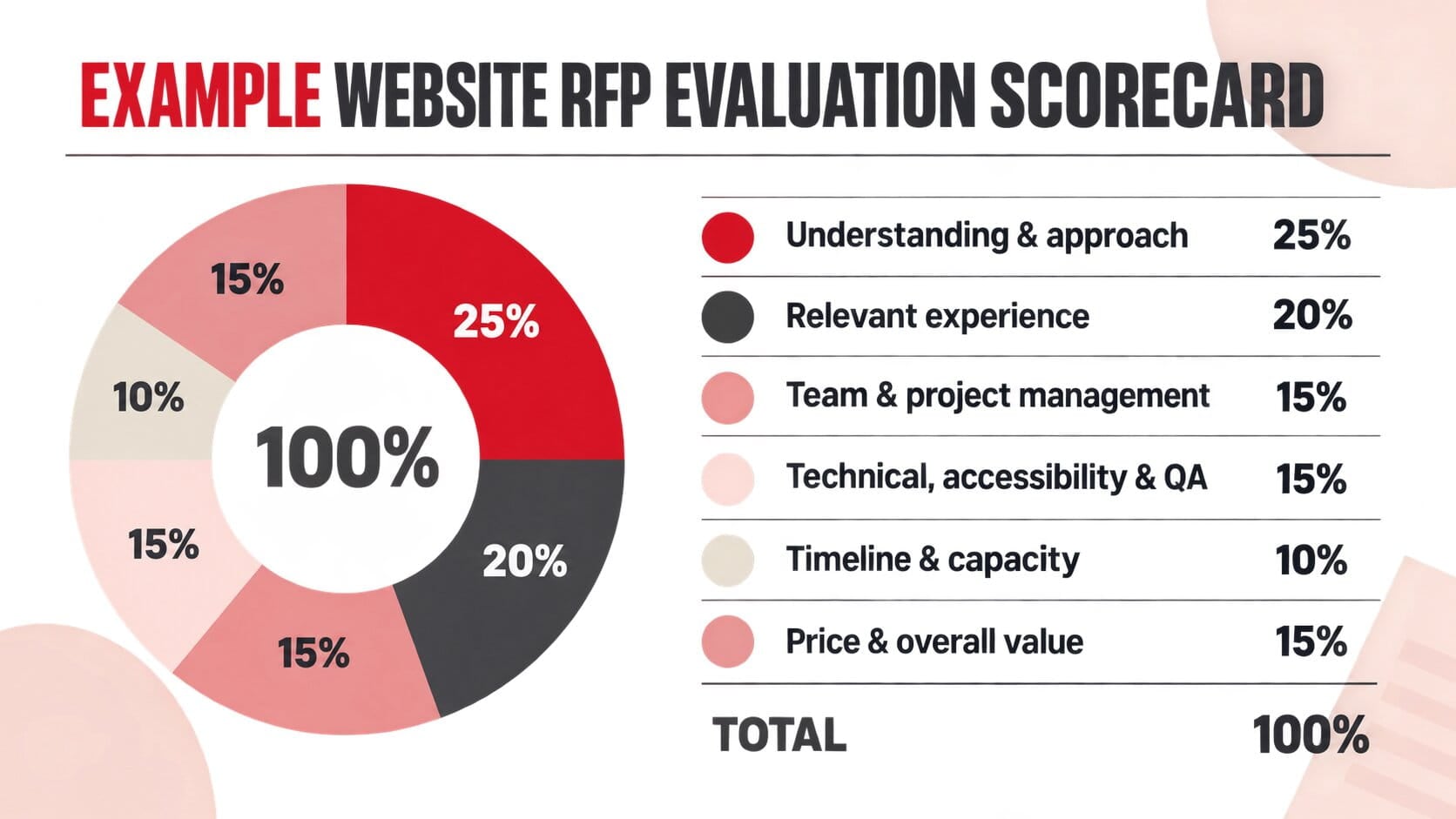
Tell vendors exactly what to submit and in what order. Request a concise understanding of the challenge, proposed approach, project team, relevant work, schedule, assumptions, exclusions, fee breakdown, references and contract exceptions. Set a reasonable page limit if long responses would burden the evaluation team.
Publish the evaluation criteria and apply them consistently. Price matters, but it should not be evaluated in isolation from the approach, relevant experience, team and risk. For regulated or public-sector procurement, have the final criteria and process reviewed by the appropriate internal or legal authority.