How Much Does an Ecommerce Website Cost in Canada?
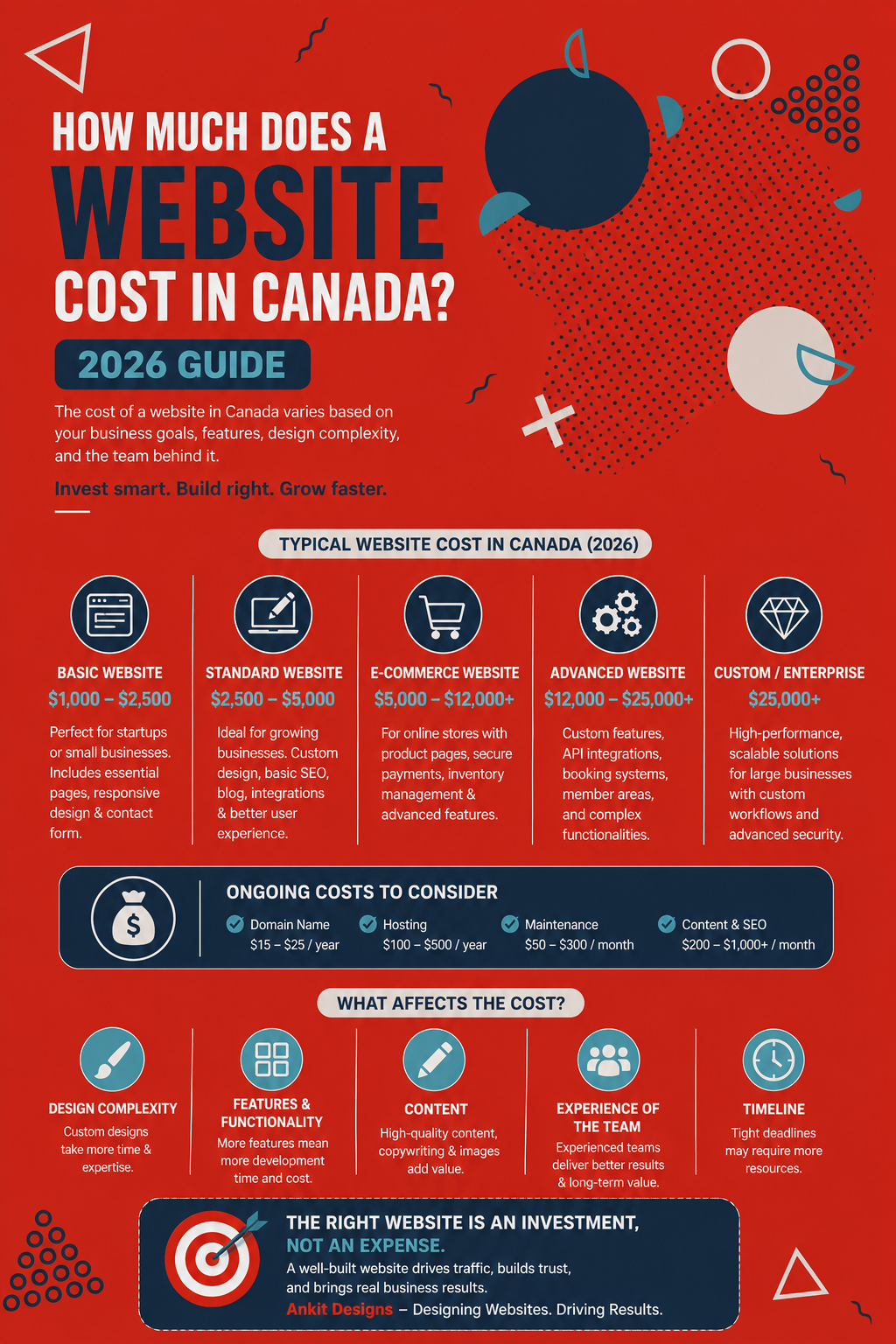
Ecommerce websites usually cost more than standard business websites because they involve additional functionality and technical requirements.
An online store may need product and category pages, inventory management, payment processing, shipping settings, customer accounts, automated emails, tax settings, security, and a properly structured checkout process.
A relatively straightforward ecommerce website might start around $5,000 to $10,000+, while more customized stores can easily move beyond $15,000 or $20,000.
The complexity of the products also matters. A store selling 20 simple products will be easier to build than one with thousands of products, multiple variations, subscriptions, customer-specific pricing, or integrations with inventory and accounting systems.
If your website is responsible for processing a meaningful portion of your company’s revenue, investing in a reliable ecommerce experience can be well worth the cost.
Why Do Professional Websites Cost More?
It is easy to look at a finished website and assume you are paying for the visible pages. In reality, professional web design involves much more.
A complete project can include discovery, research, sitemap planning, wireframes, UI/UX design, responsive design, development, content implementation, WordPress configuration, quality assurance, browser testing, performance optimization, project management, launch support, and training.
At Ankit Designs, our process includes planning, design, development, testing, launch, and ongoing support. We also place a strong emphasis on responsive design, clean development, usability, and building websites that are easy for clients to manage after launch.
This is the thinking behind our Build It Right philosophy. A website should not simply look good when it launches. It should be built properly underneath so it can continue supporting the business as it grows.
What About a $500 Website?
There will always be someone willing to build a website for less, and that is not necessarily a bad thing.
A brand-new business with a very limited budget may simply need something basic online. A simple template website can be a perfectly reasonable place to start.
The problem is expecting a $500 website to include the same strategy, customization, design quality, development, testing, support, and long-term flexibility as a professional $5,000 or $15,000 project.
Those are different products.
Lower-cost websites often rely more heavily on existing templates, require the business owner to provide most of the content, offer limited customization, and include less time for planning and testing.
If your website is essentially an online business card, that may be enough. If it is responsible for generating leads, supporting advertising, helping customers make purchasing decisions, recruiting employees, or representing an established organization, investing in quality becomes much easier to justify.
The Cheapest Website Is Not Always the Cheapest Option
The lowest initial quote can sometimes become more expensive over time.
Suppose you spend $2,000 on a website and replace it two years later because it is slow, difficult to update, poorly designed, or unable to support new features. That inexpensive website has now cost much more than the original price suggested.
There are also hidden costs associated with poor performance. A confusing mobile experience can lose potential customers. Broken forms can cost leads. Slow pages can waste advertising traffic. A difficult backend can cost employees hours every month.
Price should absolutely be part of your decision, but it should not be the only consideration.
A website is an important piece of business infrastructure. If customers regularly interact with it before deciding whether to contact or purchase from you, quality matters.
What Ongoing Website Costs Should You Expect?
Your initial website project is not necessarily your final website expense.
Most businesses should expect some combination of ongoing costs for hosting, domain registration, software licences, backups, security, maintenance, content updates, and technical support.
WordPress websites also need regular maintenance as the platform, themes, and plugins receive updates. Keeping everything current helps reduce security, compatibility, and performance issues.
Ankit Designs offers CareKit WordPress support plans for businesses that would rather have a professional team take care of updates, backups, security, and website maintenance after launch.
Building your website is the first step. Maintaining it properly helps protect that investment.