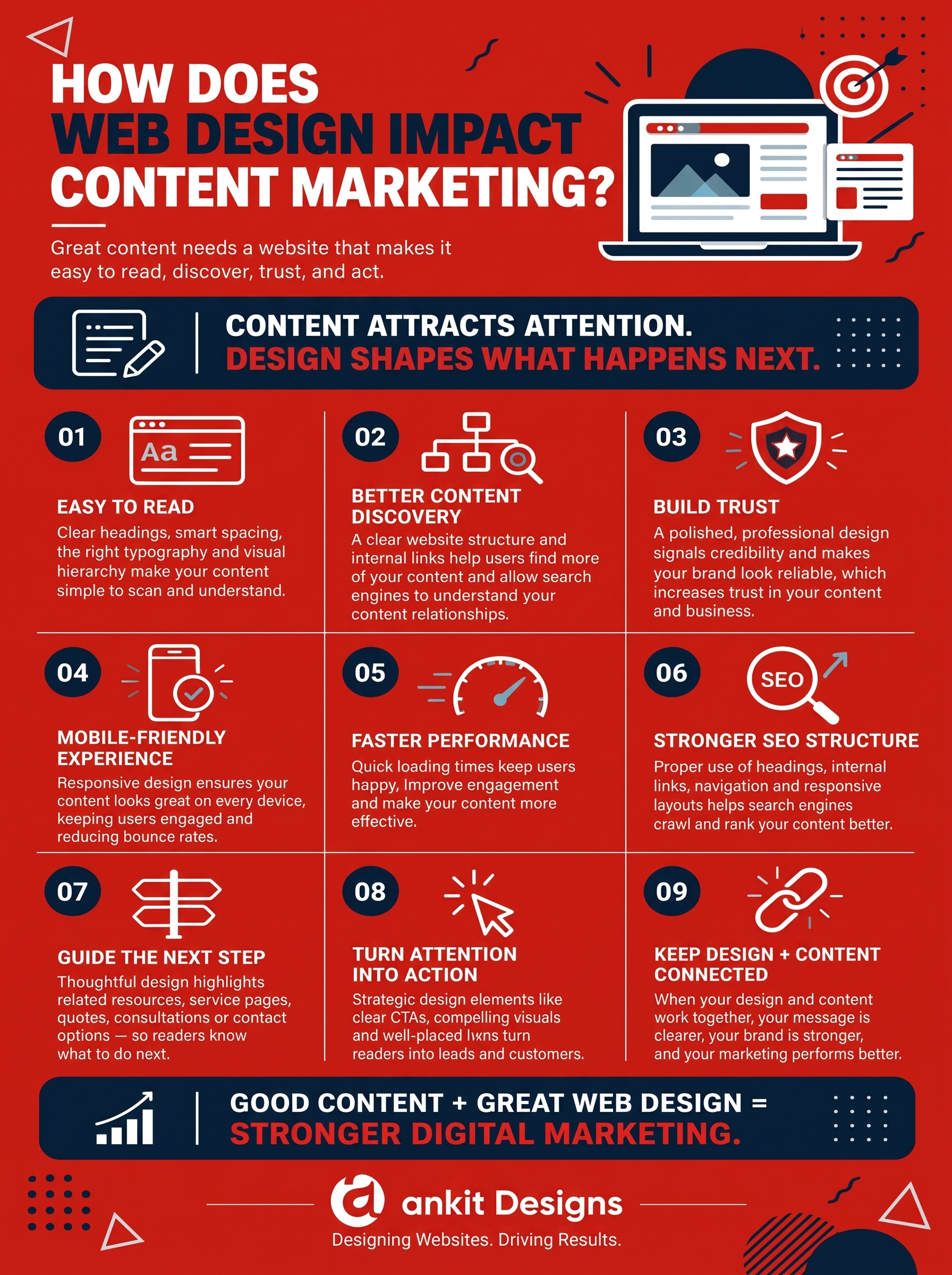
How Does Web Design Impact Content Marketing?

How Web Design Impacts Content Marketing

By Adam

How Does Web Design Impact Content Marketing?

How Does Web Design Impact Content Marketing?

How does web design impact content marketing? More than many businesses realize. You can spend hours researching topics, writing useful articles, and creating valuable resources, but the website surrounding that content plays a major role in whether people actually read it, trust it, and take action afterward.

Good content needs the right environment to perform. If a website is slow, difficult to navigate, hard to read on mobile devices, or unclear about what visitors should do next, even strong content can lose its impact. On the other hand, thoughtful web design can make content easier to discover, consume, explore, and connect to the rest of the customer journey.

That is why web design and content marketing should not be treated as completely separate strategies. Your content communicates the message, while your website determines how people experience it.

Good Web Design Makes Content Easier to Read

Readability is one of the clearest ways web design impacts content marketing. Visitors rarely arrive on a page and immediately read every sentence from beginning to end. Most people scan the page first to determine whether the information looks relevant and worth their time.

Design helps make that process easier. Clear headings, comfortable spacing, readable typography, appropriately sized images, and a strong visual hierarchy allow visitors to understand how a page is organized before committing to the full article.

This becomes particularly important with long-form content. A detailed guide may contain valuable information, but if it is presented as a large wall of text, readers can feel overwhelmed before they even begin. The same information presented through logical sections and well-spaced paragraphs feels much easier to approach.

Good website design and development should therefore consider how written content will actually be consumed, not simply how the page looks from a visual perspective. The goal is to make valuable information feel accessible rather than difficult to work through.

Website Structure Helps People Discover More Content

Publishing useful content is only valuable if people can find it. A business may have dozens of strong articles, guides, case studies, and service pages, but poor navigation can leave much of that content disconnected from the rest of the website.

A well-structured website creates natural paths between related information. Someone reading an article about choosing a service provider might move to another educational guide, then visit a relevant service page before eventually contacting the business. Internal links, related articles, clear navigation, and logical website architecture can all support that journey.

This matters for content marketing because the goal is rarely to have someone read a single article and disappear. Useful content should encourage further exploration when there is relevant information available.

Website structure can support SEO as well. Search engines use internal links and site architecture to discover pages and understand relationships between different topics. When related content is organized logically, both visitors and search engines have an easier time understanding the website.

Instead of publishing a collection of isolated articles, businesses can create a connected library of information that supports broader topics, services, and customer needs.

Web Design Influences Trust and Brand Perception

People do not judge an article based on its words alone. They also form impressions based on the website presenting that information.

A useful article displayed on an outdated, confusing, or poorly designed website may struggle to create the same level of confidence as that information presented through a polished and professional experience. Design does not make inaccurate information trustworthy, but it can influence whether visitors feel comfortable spending time with the content.

Consistent branding, professional imagery, clear contact information, relevant testimonials, case studies, and an organized layout can all strengthen that impression. They connect the content to a real business rather than making the article feel like an isolated piece of information.

This is especially important when content marketing is being used to generate leads. A visitor may originally arrive looking for an answer rather than a company to hire. If the content solves their problem and the website creates a strong impression, that visitor may become more interested in the business behind it.

Strong web design helps the quality of your company and the quality of your content support each other.

Mobile Design and Website Performance Matter

Content marketing does not only happen on desktop computers. People research businesses, read articles, compare services, and make buying decisions from smartphones and tablets every day.

If an article is difficult to read on a smaller screen, visitors may leave before reaching the information they came for. Text should be readable without zooming, layouts should adapt properly, navigation should remain simple, and buttons or forms should be comfortable to use on touchscreens.

Page speed is another important part of the experience. A visitor cannot engage with your content if they become frustrated waiting for the page to load.

Large images, unnecessary scripts, excessive plugins, poorly optimized code, and other technical issues can all contribute to slower performance. Improving these areas can make it easier for users to reach the content and move between pages without unnecessary friction.

Performance also overlaps with SEO. Ankit Designs incorporates responsive design, clean development practices, performance considerations, and SEO foundations into its website builds. These technical elements help create a stronger environment for content and the marketing strategies built around it.

Web Design Can Strengthen SEO and Content Marketing

SEO and content marketing are closely connected, and web design can influence both.

A strong website gives content a logical structure. Headings can clearly organize information, internal links can connect related topics, navigation can make important pages discoverable, and responsive layouts can create a better experience across devices.

Design also influences what happens after someone reaches the website through search. Ranking an article can bring visitors to the page, but traffic alone is not the final goal. Those visitors still need to find the content useful and understand what they can do next.

This is where content and design start working toward the same business objective.

For example, someone may find an educational article through a search engine, receive a useful answer, follow an internal link to another resource, and eventually visit a service page. A clear website makes that progression feel natural rather than forcing the visitor into an immediate sales pitch.

Businesses can learn more about the relationship between these areas in Ankit Designs’ guide on how web design affects SEO.

Good Design Turns Content Attention Into Action

Content marketing often attracts people before they are ready to purchase. Someone reading an educational article may simply be researching a problem or comparing different options.

That does not mean the visit has no business value.

Strong website design gives the reader an appropriate next step when they are ready for one. Depending on the content and business, that could mean visiting a related service page, reading another article, requesting a quote, booking a consultation, or contacting the company.

The important part is context. Every article does not need to behave like an aggressive sales page. A call to action should make sense based on what the visitor has just learned and where they may be in their decision-making process.

This is also where design can affect conversions. A visitor may like your content but leave if the next step is difficult to find. Clear navigation, relevant internal links, well-placed calls to action, and simple contact options can turn the attention earned through content marketing into meaningful business opportunities.

The goal is not to pressure every reader into becoming a customer. It is to make sure the path is available when someone is ready.

What Happens When Web Design and Content Marketing Don’t Work Together?

When web design and content marketing are disconnected, businesses can end up blaming the wrong part of their strategy.

An article may be well researched and useful, but poor formatting makes it difficult to read. Strong organic traffic may reach the website, but slow performance or poor mobile usability causes visitors to leave. Valuable resources may exist, but weak internal linking makes them difficult to discover.

The same problem can happen with conversions. Content might attract the right audience, but if service pages are difficult to reach or calls to action are unclear, visitors may never move beyond the article they originally found.

Before assuming that content marketing is not working, it is worth looking at the website supporting it. Sometimes the content itself is not the problem. The website may simply be creating unnecessary friction between someone discovering the content and becoming a customer.

Why Choose Ankit Designs?

Businesses investing in content marketing need more than somewhere to publish articles. They need a website that helps that content attract attention, create trust, support SEO, and contribute to real business goals.

Ankit Designs builds custom websites around both the user experience and the needs of the business. Their approach combines professional design with responsive development, performance, SEO foundations, clear navigation, and conversion-focused thinking.

The results of that approach matter. Ankit Designs highlights tangible outcomes from its work, including increased website traffic and conversions. Its websites are designed to help businesses strengthen their online presence, communicate their value more clearly, improve the customer experience, and create stronger opportunities for visitors to become leads or customers.

Rather than using a one-size-fits-all approach, Ankit Designs begins by understanding the business, audience, goals, and requirements before moving through design, development, testing, and launch. Their development process also emphasizes clean code, responsive design, security best practices, WordPress development, and a polished experience both in front of and behind the website.

That makes Ankit Designs particularly valuable for businesses using content as part of a larger digital marketing strategy. Strong content can attract attention, while a professionally designed website can help turn that attention into deeper engagement, inquiries, conversions, and other meaningful actions.

Website support can continue after launch as well. Through the CareKit WordPress Support Plan, Ankit Designs provides ongoing monitoring, updates, backups, human checks, support, and reporting to help businesses maintain their WordPress websites over time.

The goal is not simply to create a website that looks better. It is to build it right so the website can become a stronger platform for content, marketing, and business growth.

Does Better Web Design Improve Content Marketing?

Better web design can make content marketing more effective by reducing the obstacles between the content and the people it is intended to reach.

Design cannot make poor content valuable, and it cannot guarantee search rankings or conversions. What it can do is create a better environment for strong content to perform.

When pages are easy to read, navigation is intuitive, mobile experiences work properly, website performance is strong, and relevant next steps are clear, visitors have more opportunities to engage with the information and continue exploring the business.

Sometimes improving content performance does not require publishing more articles. Improving the website around the content may allow the content you already have to work harder.


Final Thoughts: How Does Web Design Impact Content Marketing?

So, how does web design impact content marketing? It shapes how people discover, read, trust, explore, and act on the content your business creates.

Strong content may attract someone to your website, but the experience surrounding that content influences what happens next. Readability, navigation, mobile usability, performance, internal linking, SEO structure, and calls to action all contribute to whether the visit ends with a quick exit or develops into a deeper relationship with the business.

The strongest content strategies therefore do not treat website design as an afterthought. Content and web design should support each other from the beginning.

If your business is creating valuable content but your website is not turning that attention into the results you want, contact Ankit Designs to discuss how a stronger website could support your content, conversions, and broader digital marketing strategy.

FAQs

Why is website navigation important for content marketing?

Website navigation helps visitors discover related articles, resources, products, and services. Clear navigation and internal linking can keep visitors exploring relevant content instead of leaving after reading a single page.

Does mobile design affect content performance?

Yes. If content is difficult to read or navigate on a smartphone, visitors may leave before engaging with it. Responsive design helps content adapt to different screen sizes and creates a more consistent experience across devices.

Should a business redesign its website before starting content marketing?

Not necessarily. A complete redesign isn’t always required. Businesses should first identify problems with navigation, mobile usability, page speed, content structure, internal linking, and conversions. Some websites can support content marketing effectively after targeted improvements.

How often should a business update its website design?

There is no universal schedule. Businesses should evaluate their website when their branding, audience, technology, performance, user behavior, or business goals change. Regular monitoring can help identify when a redesign or targeted improvements are needed.

Ready to Make Your Website Work Harder for Your Content?

If you’re creating valuable content but feel your website isn’t helping that content perform, it may be time to look at the bigger picture.

At Ankit Designs, we can help you evaluate your website’s design, structure, usability, performance, and overall digital experience.

Contact us to discuss your website and find practical ways to make it work better for your content marketing strategy.

Get in touch with our team today to schedule a consultation and discover how we can create a website tailored to your business goals.

About the author

I'm nobody's taxi service but I take pride in driving the bus! Upbeat, energetic serial entrepreneur on the quest to serve and help people. I enjoy long walks on short beaches and adventurous, adrenaline-pumping activities. I'm a normal bloke doing abnormal bloke things!
Read more posts by Adam
Phone Icon
Call Us
Contact Icon
Contact