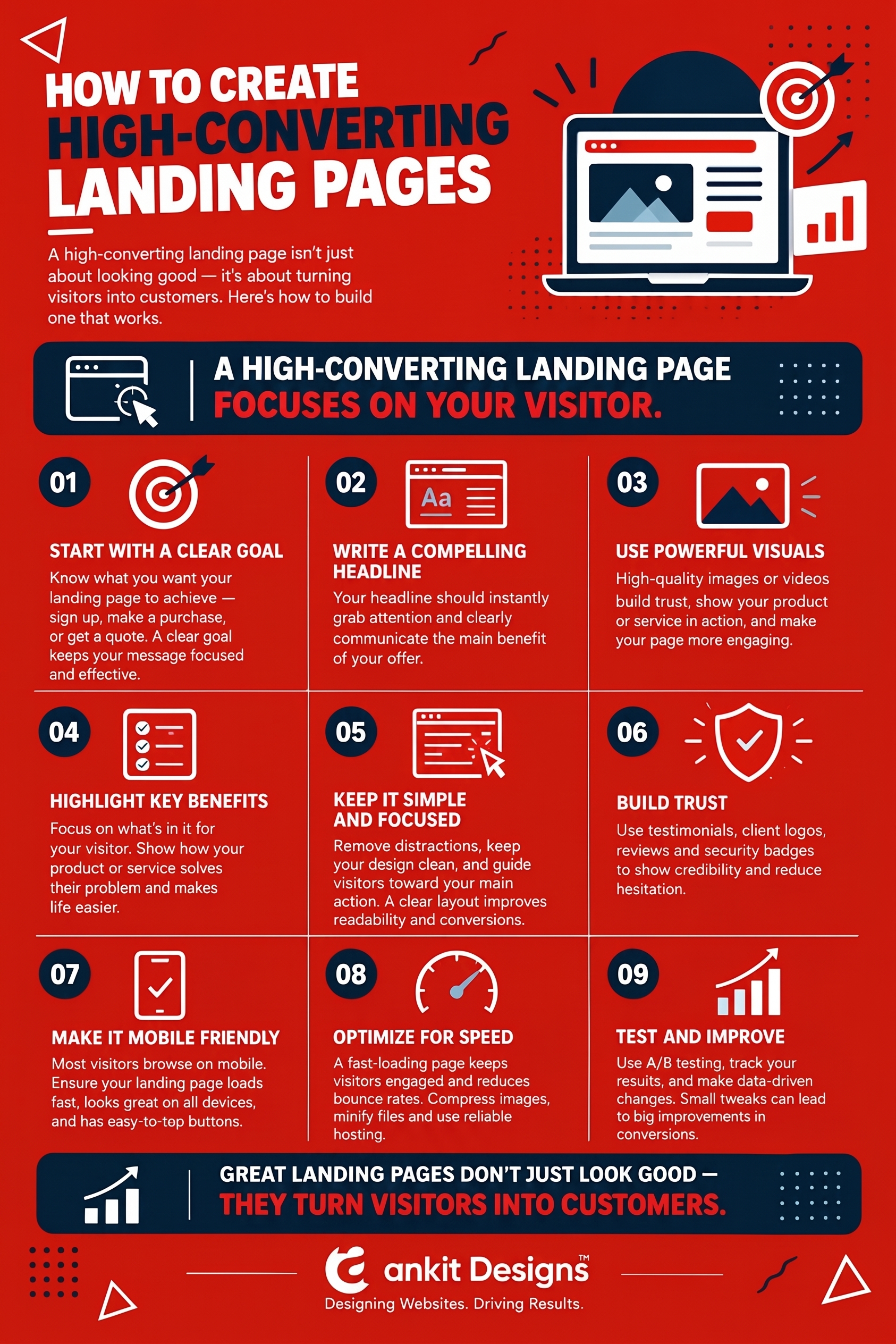
How to Create High-Converting Landing Pages

How to Create High-Converting Landing Pages That Generate More Leads

By Adam

How to Create High-Converting Landing Pages

How to Create High-Converting Landing Pages That Generate More Leads

Are people visiting your landing page but leaving without filling out a form, booking a consultation, requesting a quote, or making a purchase? If you are attracting traffic but not seeing enough results, the problem may be what happens after visitors arrive.

Learning how to create high-converting landing pages involves much more than designing an attractive page. A strong landing page communicates value quickly, keeps the visitor focused, builds confidence, and makes the next step easy to understand.

Unlike a standard website page, a landing page is usually built around one specific goal. Every major element, from the headline and copy to the design and call to action, should support that goal.

What Makes a Landing Page High-Converting?

A high-converting landing page gives the right visitor a clear reason to take a specific action. It combines relevant messaging, strong design, trust signals, an obvious call to action, and a simple conversion process.

The most important principle is focus.

A landing page should not try to accomplish everything your website does. If the purpose of the page is to generate consultation requests, the content should help someone understand the offer, become comfortable with the business, and book that consultation. If the goal is a purchase, the page should remove the questions and barriers standing between the visitor and that purchase.

The clearer the objective is, the easier it becomes to decide what belongs on the page and what does not.

Start With a Clear Goal and Strong Value Proposition

Before thinking about colours, images, buttons, or page layouts, decide what you want the visitor to do.

The primary action might be requesting a quote, booking an appointment, making a purchase, downloading a resource, or contacting the business. There can still be supporting links on the page when necessary, but one conversion should receive most of the attention.

Once you know the goal, the next step is explaining why the visitor should care.

Your headline is one of the first opportunities to do this. Generic messaging such as “Welcome to Our Company” tells visitors almost nothing. A stronger headline communicates the offer or outcome and helps reassure people that they have reached the right page.

The supporting copy should then explain what you are offering, who it is for, and how it helps. Focus on benefits rather than relying only on features. Saying that a website is responsive describes a feature. Explaining that customers will be able to use the website smoothly across phones, tablets, and desktops explains why that feature matters.

Clear landing page copy connects what you provide with the problem the customer wants solved.

Keep the Page Focused and Easy to Follow

A landing page should give visitors enough information to make a decision without overwhelming them with unnecessary options.

This is one reason landing pages often have simpler navigation and fewer competing links than standard website pages. If someone arrives after clicking an advertisement for a particular service, the page should continue that conversation instead of sending them through several unrelated parts of the website.

Design plays an important role here. Strong visual hierarchy helps visitors understand what matters first, what information supports the offer, and where they should go next.

A page might begin with a clear headline and short value proposition, move into benefits and supporting information, provide evidence that builds trust, and then present a clear call to action. More detail can follow for visitors who need additional reassurance before making a decision.

Professional website design and development should support this journey rather than simply make the landing page look attractive. The design should make the message easier to understand and the desired action easier to complete.

Use Calls to Action That Make the Next Step Clear

Your call to action tells visitors what happens next.

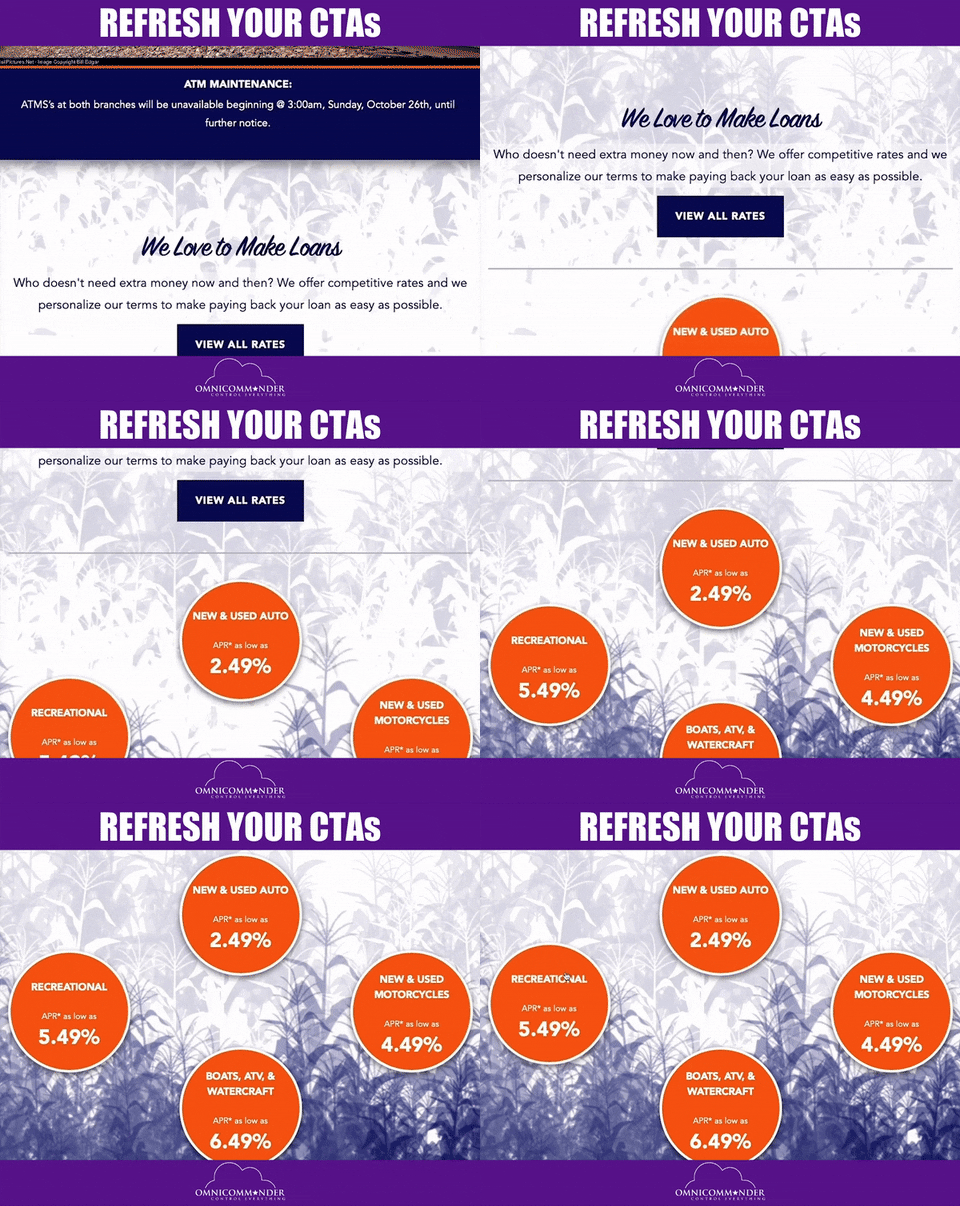
Generic buttons such as “Submit” or “Click Here” provide very little context. More specific language such as “Request a Quote,” “Book a Consultation,” or “Start Your Project” makes the action clearer.

Placement matters as well. Visitors should not have to search the page to figure out how to convert. On longer landing pages, the same primary call to action can appear again at logical points after the visitor has received additional information.

Consistency is important. If the main goal is to request a consultation, the page should not constantly switch between competing messages such as “Contact Us,” “Learn More,” “Get Started,” and “Book Now” when they all lead toward essentially the same outcome.

The easier the next step is to understand, the less unnecessary decision-making you create for the visitor.

Build Trust Before Asking Visitors to Convert

A landing page may be someone’s first interaction with your business. Before they provide personal information, spend money, or schedule a call, they may want evidence that they can trust the company behind the offer.

Testimonials, reviews, case studies, past work, client logos, credentials, and other relevant proof can help reduce that hesitation. The strongest trust signals are usually those that relate directly to the decision the visitor is making.

For example, a detailed testimonial describing the problem a customer had and the result they experienced can be more persuasive than a generic statement saying a business was “great to work with.”

Trust also comes from the overall quality of the experience. Clear writing, professional design, consistent branding, transparent contact information, and a page that works properly all contribute to how visitors perceive the business.

You do not need to cover the landing page with every review, award, logo, or credential you have. Choose proof that strengthens the message rather than distracting from it.

Make Forms and Mobile Conversion Easy

Every extra step between a visitor and the desired action creates another opportunity for them to leave.

This is especially important with forms. Ask for the information you genuinely need to follow up with or qualify the lead. A simple inquiry may only require a name, email address, phone number, and short message, while a more complex B2B service may reasonably need additional project information.

The right form length depends on the business and the value of the conversion. The goal is not always to make the form as short as possible. It is to avoid collecting information that serves no useful purpose.

The entire process should also work properly on mobile devices. Visitors should be able to read the headline, understand the offer, tap buttons, complete forms, and navigate the page without zooming or struggling with broken layouts.

Page performance matters for the same reason. Large files, poorly optimized media, excessive scripts, or other technical issues can create friction before someone even has the opportunity to consider the offer.

A high-converting landing page needs to work as smoothly as it looks.

Match the Landing Page to Visitor Intent

Not every person reaching a landing page arrives with the same expectations.

Someone clicking a paid search advertisement for a specific service may already know what they need and be close to contacting a provider. Someone arriving from an educational article may still be comparing options.

Your landing page should reflect that context.

If an advertisement promises a specific consultation, product, service, or offer, the landing page should immediately reinforce that message. A visitor should not wonder whether they clicked the wrong link.

This connection between the traffic source and the landing page is sometimes called message match. Keeping the offer, language, audience, and expectations consistent reduces confusion and allows the visitor to continue the journey they already started.

It also means businesses may benefit from creating dedicated landing pages for important campaigns rather than directing every type of traffic to the homepage.

Ankit Designs specifically creates focused landing pages built around particular campaigns and conversion goals, allowing the content and design of the page to support what that audience is being asked to do.

Measure and Improve Landing Page Performance

A landing page is not successful simply because it receives traffic. What matters is whether the right visitors are completing the action the page was designed to generate.

Conversion rate is one useful metric, but it should be considered alongside the actual business outcome. Depending on the campaign, that might mean leads generated, consultation bookings, qualified inquiries, sales, or cost per lead.

A page receiving fewer visitors but generating highly qualified leads may be much more valuable than a page attracting large amounts of traffic with very few meaningful conversions.

Businesses can also test changes when enough traffic and conversion data are available. Headlines, calls to action, forms, page layouts, offers, and supporting proof are all potential areas for experimentation.

The important thing is to make changes based on a reason rather than personal preference. If visitors are abandoning a lengthy form, reducing unnecessary fields may be worth testing. If people are reaching the page but rarely clicking the CTA, the messaging, placement, or offer may deserve attention.

Landing page optimization should be an ongoing process of understanding visitor behaviour and improving the experience where appropriate.

Why Choose Ankit Designs for Landing Page Design?

Creating a high-converting landing page requires more than arranging a headline, image, and button on a screen. The page needs to support the broader goal of the campaign and give visitors a clear path from initial interest to meaningful action.

Ankit Designs creates custom websites and focused landing pages around the needs, audience, and goals of the business. Their approach combines professional design with responsive development, performance considerations, SEO foundations, usability, and conversion-focused thinking.

Most importantly, their work is built around business results. Ankit Designs highlights tangible outcomes achieved for clients, including increased website traffic and conversions. Their websites are designed to create stronger digital experiences that help businesses communicate their value, build trust, and create more opportunities for visitors to become leads or customers.

For landing pages specifically, this means looking beyond aesthetics. A strong page needs persuasive messaging, clear visual hierarchy, relevant trust signals, a focused call to action, and a design that works smoothly across devices. Ankit Designs builds dedicated landing pages around clear conversion goals so campaigns have a more relevant destination than a generic website page.

Their broader website process also begins with understanding the business and its requirements before moving through design, development, testing, launch, and support. This helps ensure the finished page fits into the company’s wider website and marketing strategy rather than operating as an isolated design.

Businesses that need continued WordPress support can also use the CareKit WordPress Support Plan for ongoing updates, backups, monitoring, human checks, support, and reporting.

The goal is to build it right: create a landing page that looks professional while giving the business a stronger opportunity to turn valuable traffic into inquiries, conversions, and customers.

Final Thoughts: How to Create High-Converting Landing Pages

Learning how to create high-converting landing pages is not about finding one design formula that works for every business.

It starts with understanding what visitors want and what may stop them from taking action. The page then needs to communicate the offer clearly, establish value, build trust, remove unnecessary distractions, and make the conversion process simple.

Traffic alone is not enough if the people reaching your website are not taking meaningful action. In some cases, improving the landing page experience can be more valuable than simply trying to attract more visitors.

If your landing pages are receiving traffic but not generating the results you expect, contact Ankit Designs to discuss how a more focused landing page experience could help support your leads, conversions, and broader business goals.

FAQs

What is a high-converting landing page?

A high-converting landing page is a focused page designed to encourage a specific audience to complete a particular action, such as requesting a quote, booking a consultation, making a purchase, or submitting an inquiry. Strong landing pages combine clear messaging, relevant proof, professional design, and a simple conversion path.

What should a landing page include?

Most effective landing pages include a clear headline, strong value proposition, relevant supporting information, trust signals, an obvious call to action, and an appropriate conversion method such as a form or booking option. The page should also work properly across mobile devices and load efficiently.

How long should a landing page be?

There is no ideal length for every landing page. A straightforward offer may require relatively little explanation, while a complex or higher-value service may need more information, evidence, objection handling, or FAQs. The page should be long enough to support the visitor’s decision without adding unnecessary content.

What is a good landing page conversion rate?

There is no universal conversion rate that determines whether a landing page is successful. Performance varies based on the industry, audience, traffic source, offer, price, and conversion goal. Businesses should consider their own historical performance and, more importantly, the quality and business value of the conversions being generated.

Can better landing page design generate more leads?

Better landing page design can remove friction and create a clearer path toward conversion. Strong messaging, relevant trust signals, intuitive design, easy-to-use forms, mobile responsiveness, and focused calls to action can give qualified visitors a better opportunity to become leads, although results will depend on factors such as the offer, audience, and traffic quality.

Ready to Build a Landing Page That Works Harder?

If your landing page is attracting visitors but not generating enough leads, the issue may be the experience you are giving those visitors after they arrive.

At Ankit Designs, we can help you create a website and landing page experience built around clarity, usability, performance, and your business goals. Contact us to discuss your landing page or web design project.

Get in touch with our team today to schedule a consultation and discover how we can create a website tailored to your business goals.

About the author

I'm nobody's taxi service but I take pride in driving the bus! Upbeat, energetic serial entrepreneur on the quest to serve and help people. I enjoy long walks on short beaches and adventurous, adrenaline-pumping activities. I'm a normal bloke doing abnormal bloke things!
Read more posts by Adam
Phone Icon
Call Us
Contact Icon
Contact