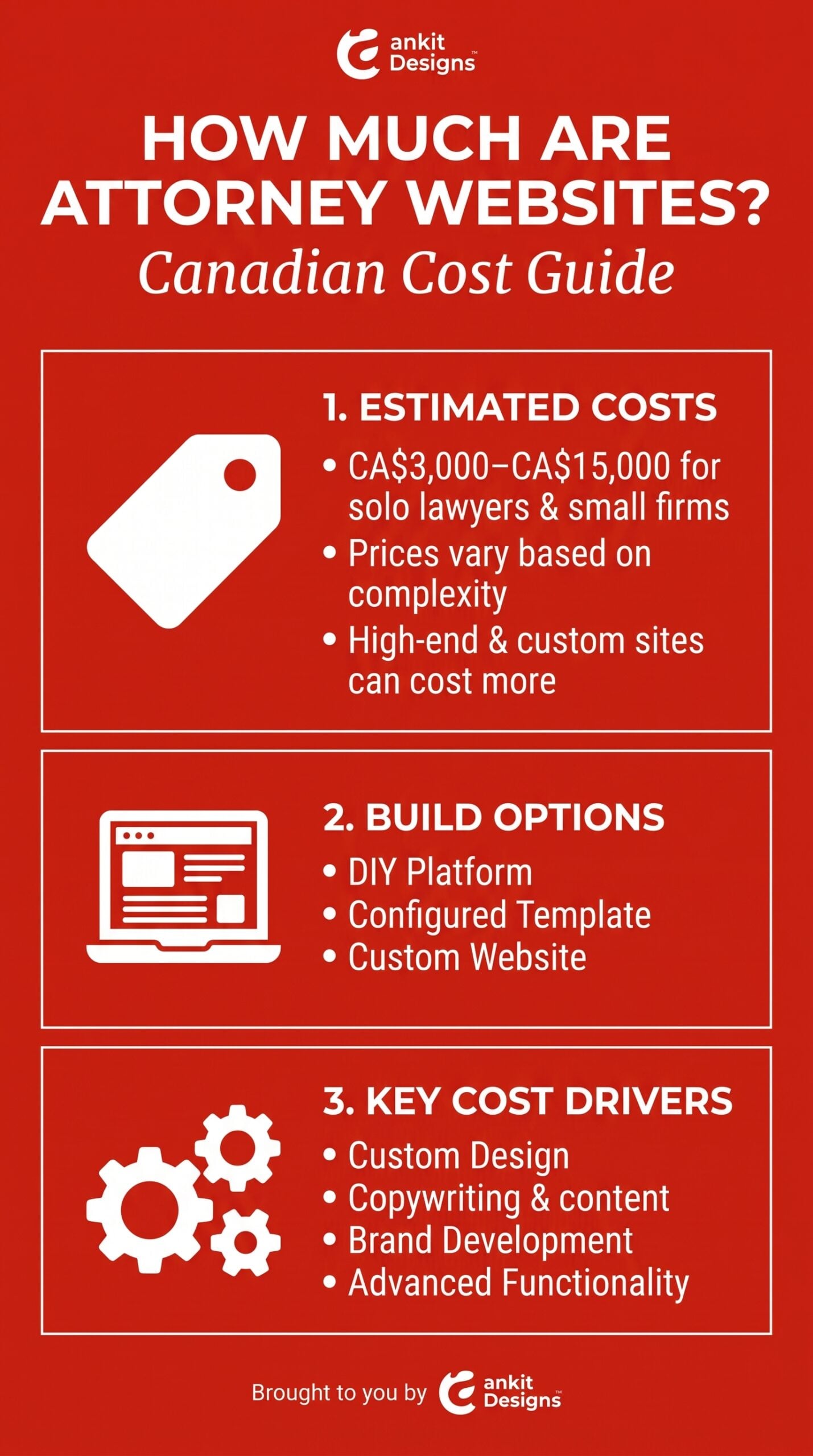
How Much Does a Law Firm Website Cost?
Your budget depends on the website’s requirements and how much work your firm handles internally. Separate platform subscriptions from professional design fees, then compare the content, functionality, and support included.
Compare DIY, Template-Based, and Custom Websites
Forbes Advisor’s website cost guide explains that professional website quotes can range from a few hundred dollars to tens of thousands, depending on the work required. This is general website guidance, rather than a Canadian law firm pricing benchmark.
| Build option |
How pricing works |
What to confirm |
| DIY website platform |
A recurring subscription, plus any paid tools and professional assistance. |
Billing period, renewal rates, features, and work your team must complete. |
| Professionally configured template |
Design and setup fees, plus platform or hosting expenses. |
Layout customization, copywriting, page setup, testing, and support. |
| Custom website |
A project quote based on design, content, development, and functionality. |
Unique layouts, integrations, migration, revisions, ownership, and handover. |
For a direct platform example, WordPress.com’s official pricing page lists its Personal plan at US$4 per month when billed annually, compared with US$9 on monthly billing, before taxes. These are platform charges, not the cost of hiring someone to plan, write, and build your firm’s website.
These approaches overlap. A professional designer may customize a template or develop original layouts. Ask exactly what the proposed work includes.
For your Canadian law firm, request an itemized quote in CAD covering the initial build and recurring expenses. A focused website with a few practice areas requires different work from a multi-office site with searchable lawyer profiles and connected intake systems.
What Drives Attorney Website Design Costs?
The price of a law firm website reflects the work required to plan, create, test, and launch it. Two proposals with the same page count can involve very different deliverables.
Page Structure, Custom Design, and Branding
Ask how many unique layouts your website needs. Ten lawyer biographies using one consistent template involve different design work from ten pages with individual layouts and functions.
Your scope may also include:
- Brand development: A new logo, colours, typography, or messaging.
- Content organization: Planning practice areas, lawyer profiles, and office pages.
- Custom functionality: Searchable directories, filters, or multilingual navigation.
An established firm with approved branding and organized content may need less preparation than a practice starting from scratch. Confirm which assets your designer can reuse.
Copywriting, Photography, and Content Migration
Writing practice area pages and biographies takes research, drafting, review, and revisions. Identify who completes each step and whether legal website copywriting is included in the quote.
Existing content also needs attention during a redesign. Your provider may need to inventory pages, remove outdated information, transfer articles, and redirect old URLs to relevant replacements.
Budget separately for professional photography or licensed imagery where required. Ask how many pages and revision rounds the content allowance covers.
Forms, Booking, and Practice-Management Integrations
A basic consultation form requires different work from an intake process connected to scheduling or practice-management software.
Clarify whether the project involves embedding an existing tool, configuring a supported connection, or developing a custom integration. Include field mapping, notifications, error handling, and testing in the scope.
Software subscriptions may continue after launch. Connecting an existing client portal also differs substantially from building one, so define the requirement before requesting a price.
DIY, Freelancer, or Agency: What Are You Paying For?
Each approach divides the work differently. Compare who will plan the website, create its content, configure tools, and check that everything works before launch.
Compare Responsibilities and Deliverables
| Approach |
What you may receive |
What your firm should confirm |
| DIY platform |
Templates, editing tools, hosting, and platform support. |
Who handles content, setup, testing, and ongoing updates. |
| Freelancer |
Agreed design or development services with direct communication. |
Whether writing, integrations, project coordination, and support are included. |
| Agency |
A coordinated team covering the services listed in its proposal. |
Who manages delivery and which specialist tasks are included. |
Provider type alone does not establish quality. Request relevant examples and ask the provider to explain its role, the requirements involved, and how the finished work was tested.
Account for your team’s contribution, too. Preparing biographies, approving legal content, and reviewing designs require staff time under any approach.
Where Professional Planning and Development Add Value
Professional support can help turn broad requests into defined requirements. Instead of asking for “online booking,” specify whether visitors request a consultation or reserve an available appointment, and how staff receives that information.
Ankit Designs lists WordPress development, pre-launch testing, and project-dependent integrations among its services. Ask how those capabilities apply to your firm’s scope and what evidence you will receive at handover.
What Ongoing Website Costs Should You Budget For?
The build price is one part of your attorney website budget. After launch, your firm may pay for hosting, software, maintenance, content changes, and marketing services. Check which expenses are bundled and which are billed separately.
Hosting, Software, Maintenance, and Support
Request a written breakdown of recurring charges, including:
- Domain registration: Renewal fees and account ownership.
- Hosting: The service provided, renewal price, and support arrangements.
- Software licences: Paid themes, plugins, scheduling tools, and integrations.
- Maintenance: Updates, backups, monitoring, and recovery responsibilities.
- Support: Included assistance, response arrangements, and charges for additional work.
Ask whether a maintenance plan includes content edits or only technical upkeep. Updating a lawyer’s biography, adding a practice area, and developing a new feature may fall under different billing terms.
Ankit Designs lists ongoing WordPress support through CareKit. Confirm the package’s current scope, exclusions, and pricing when discussing your project.
SEO, Content, and Advertising Expenses
Separate the work needed to launch your website from services purchased to develop its visibility afterwards.
Foundational SEO may include page titles, headings, internal links, and indexability checks. Ongoing SEO can involve additional research, content development, technical improvements, and reporting. Ask the provider to specify its deliverables.
Likewise, distinguish advertising management fees from the budget paid to advertising platforms. Include these services in your wider marketing plan without assuming they are part of the website contract.