What Is Web Hosting? A Simple Guide
What Is Web Hosting? A Simple Guide for Business Owners
Every website needs somewhere to live on the internet. Whether you're shopping online, booking an appointment, or browsing a local business's services, the website you're visiting relies on web hosting to function.
But what is web hosting, and why is it important for your business?
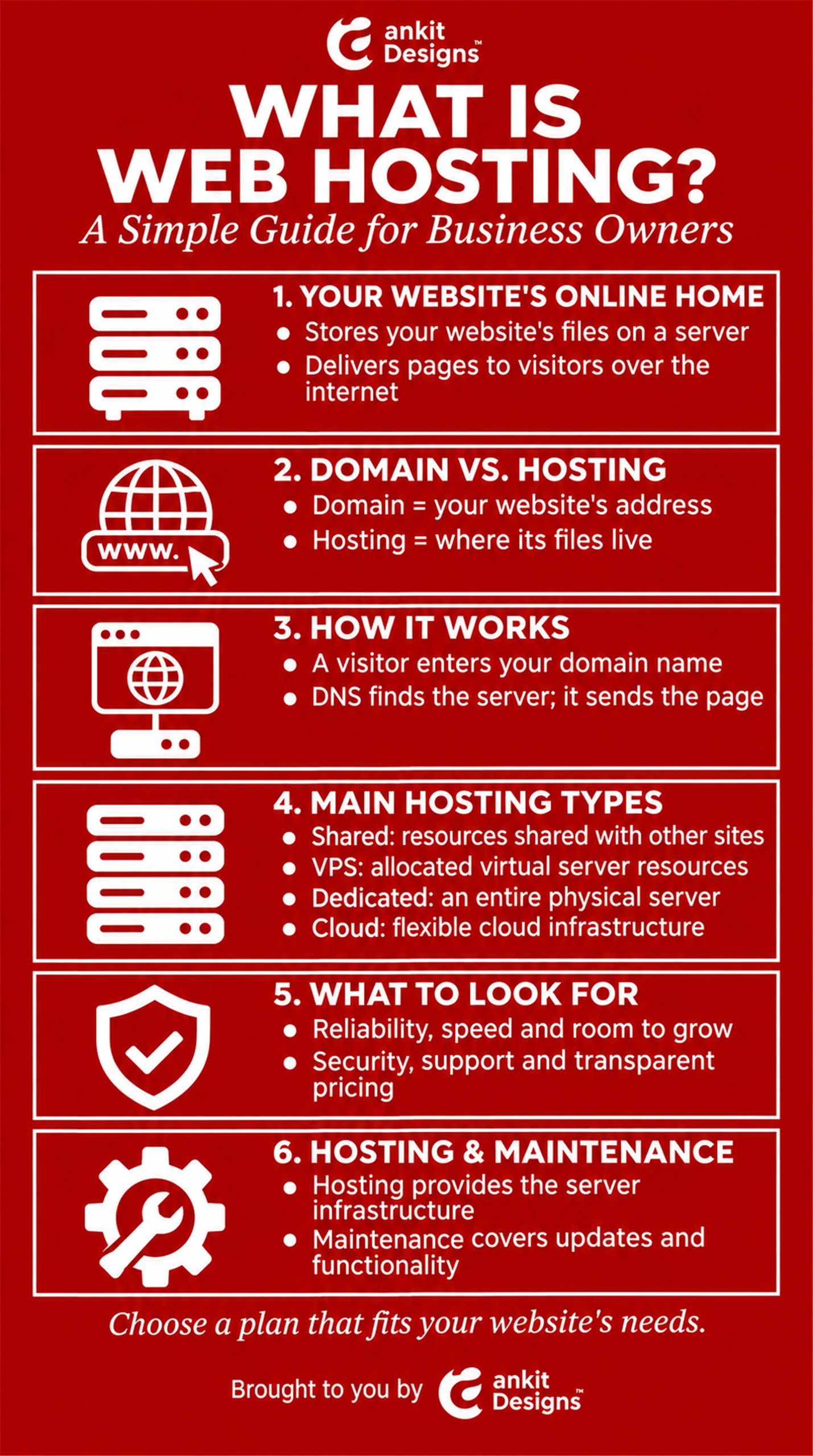
Web hosting is a service that stores your website's files on a server and makes them accessible to visitors over the internet. Without web hosting, your website wouldn't have the infrastructure it needs to appear online.
For business owners in Toronto and across the GTA, understanding web hosting can help you make informed decisions about website performance, security, and ongoing maintenance.
In this guide, we'll explain how web hosting works, the different types available, and what to consider when choosing a reliable hosting provider.

What Is Web Hosting and How Does It Work?
Web hosting provides the server space and resources needed to make a website accessible online.
Every website contains files, including images, text, code, and sometimes databases. These files need to be stored on a server so visitors can access them whenever they visit your website.
A web hosting provider maintains the server infrastructure responsible for storing and delivering this information.
When someone visits your website, the process generally works as follows:
- A visitor enters your domain name. Someone types your website address into their browser or clicks a link.
- The browser identifies the correct server. The Domain Name System (DNS) helps direct the browser to the server associated with your domain.
- The server processes the request. Your hosting server retrieves the information needed to display the requested webpage.
- The website appears. The browser receives the necessary resources and displays your website.
This entire process usually happens within seconds.
For example, when someone searches for a Toronto accounting firm and clicks its website, the hosting infrastructure helps deliver the business's service pages, contact information, and other content.
A properly configured hosting environment helps keep these pages accessible so potential customers can learn about your business and get in touch.
What's the Difference Between Web Hosting and a Domain Name?
Web hosting and domain names work together, but they serve different purposes.
A domain name is the address people use to find your website, such as yourbusiness.com.
Web hosting provides the server infrastructure where your website's files are stored and delivered to visitors.
Think of it like a physical store:
- Domain name: The street address customers use to locate your business.
- Web hosting: The building and infrastructure where your business operates.
- Website: The actual store, including its design, products, and information.
For a traditional business website, you generally need both a domain name and hosting.
Purchasing a domain name doesn't automatically mean your website is ready to go live. You'll still need somewhere to store its content.
Likewise, purchasing hosting doesn't necessarily mean you have a custom domain name.
Some website-building platforms bundle hosting and domain registration into their packages, but it's important to understand what services you're purchasing and who manages them.
Why Is Web Hosting Important for Your Business?
Choosing a reliable hosting provider is an important part of operating a professional business website.
While web design and content influence how visitors experience your website, hosting helps support the technical infrastructure behind it.
Here are some of the main reasons web hosting matters.
1. Website Reliability and Availability
Your website should be accessible whenever potential customers want to visit it.
For example, someone researching a Toronto landscaping company might browse its services after work, while another customer might submit a quote request early in the morning.
Unlike a physical storefront, your website can provide information outside regular business hours.
Reliable hosting helps support website availability and minimize disruptions caused by server-related issues.
When choosing a provider, review its uptime commitments, monitoring practices, and technical support options.
Although no provider can guarantee that outages will never occur, dependable infrastructure helps reduce the likelihood of avoidable interruptions.
2. Website Loading Speed
Website speed affects how easily visitors can navigate your content.
Slow-loading pages can make it frustrating to browse products, read information, or complete contact forms.
Your hosting environment can influence website speed through server resources, storage technology, and network infrastructure.
However, hosting isn't the only factor affecting performance.
Large images, inefficient code, excessive plugins, and poorly configured websites can also contribute to slow loading times.
Choosing appropriate hosting and maintaining an efficiently developed website can help provide a better browsing experience.
3. Website Security
Business websites may collect information through contact forms, customer accounts, or online transactions.
A secure hosting environment is one part of protecting that information.
Depending on the hosting provider and plan, security features may include SSL certificates, server monitoring, access controls, and other protective measures.
SSL certificates support encrypted connections between your website and its visitors through HTTPS.
However, hosting security doesn't replace the need for software updates, secure passwords, backups, and proper website maintenance.
Businesses should consider hosting and ongoing security practices together when evaluating their website's needs.
4. Business Growth and Scalability
Your website requirements may change as your business grows.
A small informational website might initially need relatively few resources.
However, as you add new services, upload more content, or attract additional visitors, your website may require more storage, bandwidth, and processing capacity.
For example, a Toronto retailer expanding into online sales may need hosting that can support an e-commerce platform and increased website activity.
Choosing a provider with suitable upgrade options can make it easier to accommodate these changes without unnecessary complications.
What Are the Different Types of Web Hosting?
There are several types of web hosting, each designed for different website requirements and budgets.
Understanding the differences can help you determine which option may be appropriate for your business.
Shared Hosting
Shared hosting allows multiple websites to use resources on the same physical server.
Because the infrastructure is shared, this is generally one of the more affordable hosting options.
Shared hosting may be suitable for smaller websites with basic requirements and modest traffic.
However, performance can be affected by resource limitations and the activity of other websites on the server.
For businesses operating simple informational websites, shared hosting may be a practical starting point.
VPS Hosting
Virtual Private Server (VPS) hosting uses virtualization technology to divide a physical server into separate virtual environments.
Each VPS receives allocated resources, offering greater separation and control than typical shared hosting.
This makes VPS hosting suitable for businesses that need additional flexibility or more consistent access to server resources.
VPS hosting may also provide greater control over server configurations, depending on the plan.
Ankit Designs offers VPS hosting through its KISS Hosting service, providing clients with SSD storage and hosting management options.
Dedicated Hosting
Dedicated hosting provides access to an entire physical server for one customer.
This arrangement offers greater control over the server's resources and configuration.
Dedicated hosting may be suitable for websites with significant resource demands or specialized technical requirements.
However, it generally comes at a higher cost and may require additional technical management.
For many small and medium-sized businesses, dedicated hosting isn't necessary.
Cloud Hosting
Cloud hosting uses cloud infrastructure to provide website resources.
Depending on the provider, it may allow resources to be adjusted as demand changes or distribute workloads across multiple servers.
Cloud hosting can be useful for businesses with changing traffic levels or more complex infrastructure requirements.
However, cloud hosting doesn't automatically guarantee better performance or reliability.
The actual experience depends on the provider, configuration, and resources included in the service.
What Should You Look for in a Web Hosting Provider?
Not every hosting provider offers the same features, resources, or level of support.
Before choosing a hosting plan, it's important to consider your website's requirements and how the provider can support them.
Reliability and Uptime
Look for a provider that clearly explains its uptime commitments and how it handles service interruptions.
Your website should remain accessible as consistently as possible, especially if customers rely on it to request quotes, book appointments, or make purchases.
Review any uptime guarantees carefully to understand what they cover.
Storage and Bandwidth
Storage determines how much data your hosting account can hold, including website files, images, and databases.
Bandwidth generally refers to the amount of data transferred between your website and its visitors over a given period.
A small informational website may have modest requirements, while an online store with extensive product images may need additional resources.
Choose a plan that accommodates your needs without paying for unnecessary capacity.
Security Features
Check which security features are included in the hosting package.
These may include SSL certificates, server-level protections, monitoring, and backup options.
It's also important to understand which security responsibilities belong to the hosting provider and which remain with your business.
Technical Support
Technical issues can occur even with a professionally developed website.
Before choosing a provider, find out how customers can request assistance and which problems the support team handles.
Some providers primarily support the hosting infrastructure, while others offer more comprehensive management.
For business owners without technical experience, clear and dependable support can be especially valuable.
Pricing and Flexibility
Compare the features included in each hosting plan rather than choosing based only on the monthly cost.
Some plans may appear inexpensive but exclude features your website requires.
Others may include additional resources that aren't necessary for your business.
Consider whether the provider offers flexible contracts, suitable upgrades, and transparent pricing.
How Much Does Web Hosting Cost?
The cost of web hosting depends on several factors, including hosting type, server resources, management level, and included services.
Shared hosting is generally more affordable because multiple websites share the same infrastructure.
VPS hosting typically costs more because it offers allocated virtual server resources and additional flexibility.
Dedicated hosting is often more expensive because the customer has access to an entire physical server.
Managed hosting may also carry a higher price because the provider handles additional technical responsibilities.
When comparing hosting costs, consider what's included in the package.
For example, a plan that includes SSL certificates, management, and accessible technical support may offer better overall value than a lower-priced option where these services cost extra.
The most suitable hosting plan isn't necessarily the cheapest or most expensive one. It's the option that provides the resources and support your website needs.
Does Web Hosting Affect SEO?
Web hosting can influence technical factors that are relevant to search engine optimization.
For example, slow server response times may contribute to poor loading performance, while frequent outages may prevent search engines from accessing your website.
Google uses Core Web Vitals as part of its ranking systems. These measurements evaluate aspects of website performance, including loading speed, responsiveness, and visual stability.
However, web hosting alone doesn't determine where a website ranks in search results.
Other important factors include:
- Helpful and relevant content
- Technical SEO and indexing
- Mobile-friendly website design
- Clear navigation and internal linking
- Efficient website development
- Appropriate image optimization
Businesses can use tools such as Google PageSpeed Insights to evaluate website performance and identify areas for improvement.
Reliable hosting should be viewed as part of a broader website performance and SEO strategy rather than a guaranteed way to improve rankings.
What's the Difference Between Web Hosting and Website Maintenance?
Web hosting and website maintenance are related services, but they have different purposes.
Web hosting provides the server infrastructure that makes your website available online.
Website maintenance focuses on keeping the website's software, security, and functionality up to date.
For example, website maintenance may involve:
- Updating WordPress themes and plugins
- Reviewing website backups
- Fixing broken forms or links
- Monitoring potential security issues
- Troubleshooting technical errors
- Checking website functionality
Some hosting packages include certain maintenance features, while others provide hosting and maintenance as separate services.
Before purchasing a plan, ask which responsibilities are included.
Ankit Designs also offers CareKit WordPress support and maintenance for clients who need ongoing help managing their websites.
Understanding the difference can help business owners prepare for the full cost of operating a website.
Do Small Businesses Need Professional Web Hosting?
Small businesses need reliable website infrastructure, but their hosting requirements depend on the type of website they operate.
A basic informational website may require relatively few resources.
An e-commerce store, booking platform, or website with advanced functionality may need more capable hosting.
For Toronto businesses, hosting is particularly important when the website plays a central role in attracting customers.
A contractor may rely on contact forms to receive quote requests, while a healthcare clinic may use its website to provide service information and appointment booking options.
When hosting problems make these features unavailable, potential customers may be unable to complete their intended actions.
Professional hosting can also be useful for business owners who prefer not to manage server infrastructure themselves.
The important thing is choosing a provider that matches your website's technical requirements and offers an appropriate level of support.
Simplify Website Hosting With Ankit Designs
Choosing a hosting provider can feel overwhelming, especially when you're unfamiliar with server resources, bandwidth, and technical configurations.
At Ankit Designs, we believe website hosting should be straightforward.
That's why we offer KISS Hosting, a hosting service available exclusively to Ankit Designs clients.
Our hosting service is designed to simplify website infrastructure management while providing practical features for business websites.
KISS Hosting includes:
- VPS hosting with SSD storage
- SSL certificates
- cPanel access
- Hands-off hosting management
- Month-to-month plans without long-term commitments
With different hosting plans available, clients can select an option based on their website's requirements.
Whether you're launching a new website or considering a change to your existing hosting arrangement, understanding your options can help you make a more informed decision.
Explore our website hosting services to learn more about KISS Hosting and the available plans.
Frequently Asked Questions About Web Hosting
Do I Need Web Hosting if I Have a Domain Name?
Yes. A domain name provides your website's address, while web hosting stores and delivers its content. Some website-building platforms include hosting in their subscription, but a domain name alone doesn't provide the infrastructure required to operate a traditional website.
How Much Should a Small Business Pay for Web Hosting?
Hosting costs depend on your website's size, traffic, technical requirements, and the services included. Smaller websites may use affordable shared hosting, while businesses requiring more resources or managed services may benefit from VPS or other hosting options.
Can I Change My Web Hosting Provider?
Yes. Websites can generally be migrated between compatible hosting providers. The process may involve transferring website files, databases, and configuration settings before updating DNS records. Testing the website before completing the migration can help reduce disruptions.
Is WordPress the Same as Web Hosting?
No. WordPress is a content management system used to create and manage website content. Hosting provides the server resources required to operate a self-hosted WordPress website.
What Happens if My Web Hosting Expires?
If your hosting account expires or is suspended, your website may become unavailable. Depending on the provider's policies, website files and databases may eventually be deleted. Keeping your account active and maintaining backups can help reduce the risk of losing important information.
How Do I Know Which Hosting Plan Is Right for My Business?
Consider your website's size, expected traffic, storage requirements, functionality, and available budget. A simple business website may require fewer resources than an online store or website with complex features. A hosting provider or website developer can help evaluate your requirements.
Get Reliable Website Hosting With Ankit Designs
Web hosting is an essential part of maintaining a professional website.
It provides the infrastructure needed to keep your website accessible while supporting performance, security, and future growth.
For businesses in Toronto and across the GTA, choosing the right hosting provider helps ensure customers can access important website information when they need it.
At Ankit Designs, we provide professional web design, development, and hosting services to help businesses establish and maintain their online presence.
Our KISS Hosting plans offer a straightforward approach to website hosting, with practical features and flexible month-to-month options for Ankit Designs clients.
Explore Ankit Designs' Hosting Services to learn more about our plans and find an option that meets your business's needs.
Get in touch with our team today to schedule a consultation and discover how we can create a website tailored to your business goals.
Share

About the author:
I'm nobody's taxi service but I take pride in driving the bus! Upbeat, energetic serial entrepreneur on the quest to serve and help people. I enjoy long walks on short beaches and adventurous, adrenaline-pumping activities. I'm a normal bloke doing abnormal bloke things!
